Exhibition·Kedge Business School·2026
Yesterday in Today's China
Twelve photographs, nine cities, one China
« We say modern China, we say traditional China. As if it were one or the other. The truth is that in 2026 it is both in the same square meter, without drama, without hierarchy. Twelve photos taken in nine cities, none of them cheating. »
Beijing
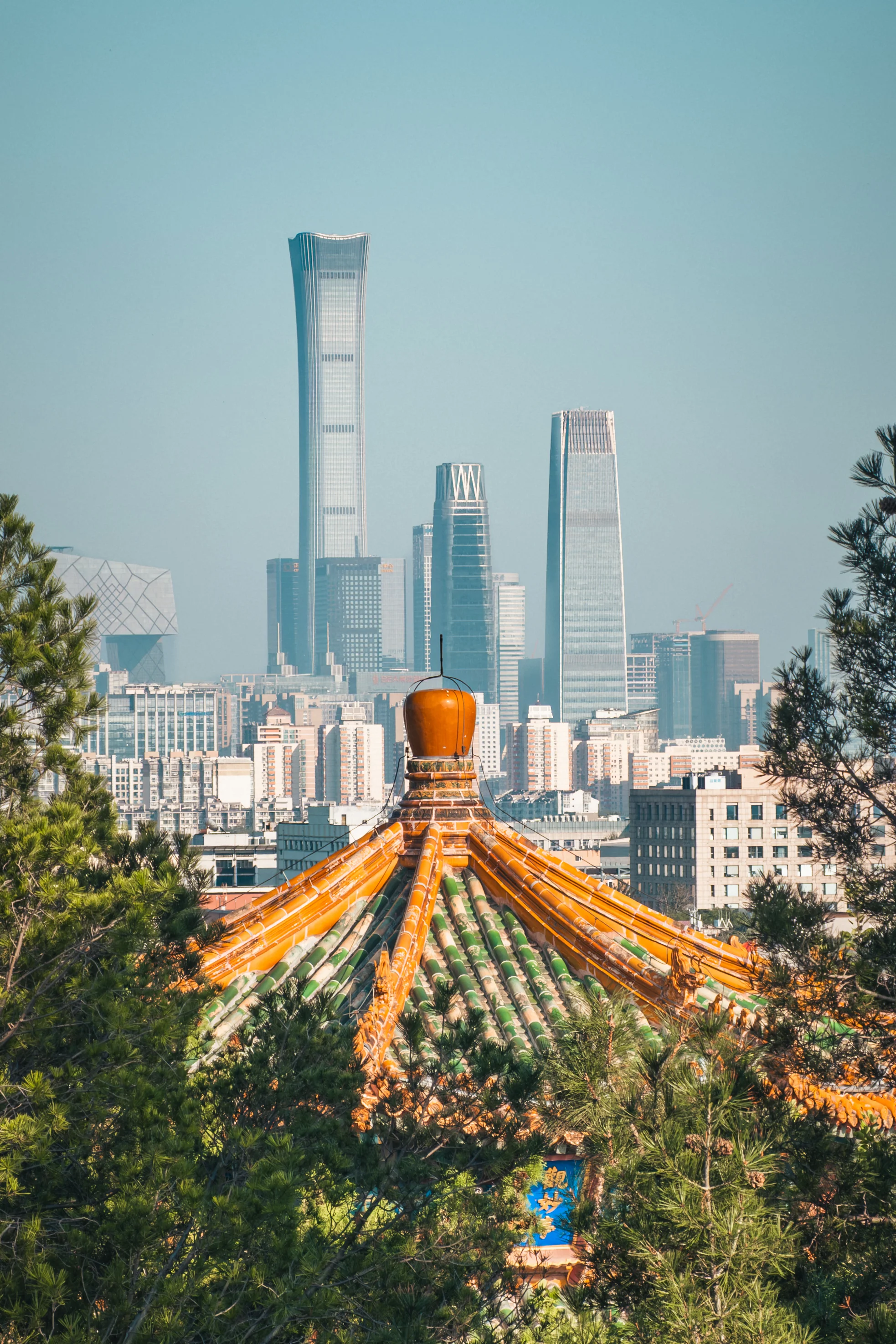
Skyline and imperial roof
I took this photo from Jingshan park, just north of the Forbidden City. It's THE classic viewpoint over Beijing. The yellow imperial roof in the foreground, the CITIC Tower rising behind to 528 meters. Nobody erased the old to grow the new. They coexist in the same frame, and nobody around me seemed to find that strange.
Zhangjiajie
White dress and red ribbons
The Zhangjiajie cliffs are what inspired the Avatar landscapes. Everyone knows it, China has made it a tourism argument. What I had not anticipated was this woman in a white dress at the edge of the void, and the red prayer ribbons hanging in the upper left. The wildest landscape in the country is also a place of pilgrimage. And an Instagram backdrop. All three at once, without it bothering anyone.
Wuzhen
Hanfu and smartphone
In Wuzhen, it has become a whole thing : you rent a hanfu, the traditional costume, you get your hair done, and you spend the day taking pictures of yourself in the alleys. It is huge among young women. At first I thought, cliché. Then I thought, no, exactly the opposite. They are not wearing a dead costume. They are putting it back into circulation. Phone in hand, but the gesture is there.
Suzhou
Canal at night
Suzhou at night, red lanterns, wooden boats, reflections on the canal. It is exactly the image you have in mind when you think 'old China'. The interesting question is who decided that this would be the image. Because a large part of these canals was restored fairly recently to look like what we expect them to look like. The postcard has become the real.
Chongqing
Hongya Cave
Hongya Cave, in Chongqing. The first time you see it lit up at night, you think 'wow, an old quarter'. In fact it is a recent reconstruction, designed to look like an ancient tiered town clinging to a cliff. Openly touristy, openly instagrammable. And yet the Chinese themselves come here in droves, without irony. This distinction between the authentic and the reconstructed, I think it is something that obsesses us. Not them.
Xi'an
Scooter and tricycle
An alley in Xi'an, a gray morning. The guy on the right rides a pedal tricycle. The electric scooter on the left carries kids behind a transparent tarp. Two eras of Chinese mobility in the same frame, without anyone but me finding it interesting. That is what I wanted to show in this series. Not China putting on a show. China just living. Without drama.
Xi'an
Morning market
Xi'an again, a few streets over. A market set up at the foot of a yellow apartment block. A grandmother choosing her vegetables. Steam from a cooking pot rising toward the electric wires. Nothing folkloric, nothing in the guidebooks, just there, every day. It is probably the least 'remarkable' photo in the series. That is exactly why I value it.
Suzhou
Baijiu shop
This shop sells baijiu, Chinese rice alcohol, on tap. The large blue and white jars on the right, that is how it works : you bring your bottle, they fill it. A trade that has not changed in centuries. While I was taking the photo, the orange cat did not move an inch. China transforms. Some trades carry on. And a cat watches.
Temple
Incense burner in the rain
A temple, a rainy day, near Chengdu. The man in blue lights incense sticks in the great burner. At the bottom of the photo, bright red Party flags. Above, an imperial roof. And he holds a modern transparent umbrella. Three eras in the same image. Nobody sees a contradiction. This might be the photo that best sums up what I understood in China : here, the sacred is neither dead nor protected. It lives with its time.
Beijing
Jingshan pavilion at sunset
Back to Jingshan park, just before sunset. Two young women have settled under an imperial pavilion to drink a Coke before heading back down. For them, this pavilion is not a monument. It is a patch of shade. And that is precisely what gets me. At Versailles, nobody sits on the floor of the Hall of Mirrors with a soda can. In Beijing, yes.
Chengdu
Woven tower
In Chengdu, at the panda research base. This giant woven tower is a contemporary observation point inspired by traditional Chinese weaving techniques. The little cart below is customized panda style, yes, everything is panda in Chengdu. Chinese modernity does not imitate ours. It looked at its own past and made something else out of it. And sometimes that something else is a rolling billboard shaped like a black and white bear.
Guilin
Li river in the morning
We end here. The Li river, in Guilin, all the way south. The karst peaks in the background, that is the millennia-old image of China, the one from Song dynasty paintings. In the foreground, a man in a conical hat picks up something along the water. Nobody told him he was inside an iconic landscape. He is doing his work. And that is it, in the end, the real China : while everything changes, somebody, somewhere, carries on.
A photographic exhibition shown at Kedge Business School. China, 2026.
Aymeric Gehres·2026